Making Mistakes When Investing

From the time we are little, we try not to make mistakes. I guess it depends on the kid but I was one of those kids who tried not to make a mistake on tests or tried not to colour over the line. My kids don’t have that problem. They may pretend to make mistakes just to see my flabbergasted face. I now see how being a perfectionist is problematic for many things in life. 

Children begin a challenging course. Get from A to B. Sounds easy but there will be difficult obstacles along the way just like investing.

One day, one of my children came home with a spelling test and he got a zero out of five. I was surprised and said honey, you got all of them wrong. He replied, no mommy, they are all…incorrect. He seemed to think he did well because he had more incorrect answers than anyone else in the class. I was not like this child at all. I’m happy he goes on in life unperturbed about making mistakes. It makes a great lesson for investing. It’s okay to make mistakes when investing especially when you are young and just starting out. 

Retain the Ability to be Wrong and Move On

Being a kid is about learning from your mistakes and being able to move on with life and try again. When investing you also have to accept that making mistakes is totally acceptable and you will only get better at investing once you make some basic ones. When I realized I made a trade in error, I called the brokerage and explained what I tried to do and they helped me correct it without any extra charges. 

There must have been some apprehension to learn how to use a Penny Farthing Bicycle. I’m sure it wasn’t that easy to get started but look how fun it looks now.

At one time, I sold a stock and got the ticker symbol wrong. I had two stocks with similar tickers. I ordered a sale of a stock and not only did I get the ticker wrong but I tried selling more than I owned of the stock, so in essence I was short selling. I realized minutes after and called the brokerage and they set everything straight, I don’t think they even charged me for all the extra orders that had to go through to fix my mistake. Other times, I’ve sold a poorly performing stock only to see it sky rocket way beyond what I originally paid for it months later. I realized that I should have had more patience and if I’m not willing to hold a stock for the long term then I shouldn’t buy it. 

Times are Always Uncertain, But Some Times are More Uncertain Than Others

I’m still investing twenty years later in extremely “uncertain times.” However, I don’t recall there ever being “certain times” in which to invest in. It’s okay to make some mistakes when investing, give yourself that leeway. Learn from making mistakes and learn from other people’s mistakes too. As long as you stay invested for a very long period, things should work out well and maybe even better than you could have anticipated, with all your mistakes and all the market crashes and corrections accounted for. Stay invested and as one investing giant has said, “just stay the course.”
Saving and Investing is a Super Power

Saving and Investing is a Super Power

Money is a sensitive topic to talk about isn’t it, and unless you work in the financial sector it is a pretty awkward subject to bring up with just about anyone. Since no one really talks about it, it seems like maybe it’s not that important. I think that finding an interest in investing is truly a super power with all this secrecy going around. I know you have that super power in you. 

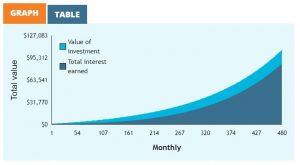
What makes it a super power is that it won’t reveal itself as a super power until later, much later. At first, when you start to save and invest you will feel powerless and it may even feel pointless. ‘Who cares I set aside $1000, that’s not a lot of money’, you’ll say. You may have it invested, and its market value could go down. ‘What’s the use!”, you’ll say to yourself each time you lose money. There will be many times when it will seem FUTILE. The super power happens when all those feelings of hopelessness are set aside and you continue to save and invest despite the mixed signals in the news and despite what your gut is telling you to do. It is a super power to keep on doing it because of the news telling you that “cash is king”, or that only real estate is a real investment because you can see it and touch it. Saving and investing in the stock market is a very abstract concept, and the ability to see its growth potential and imagine the effects of compounding is not easy. Let’s use the help of a compound interest calculator to help us see this super power in action.

Graph of our results from getsmarteraboutmoney.ca

Let’s assume you started working and after a year, you managed to save $500. You’ve opened a self-directed RRSP and have a bit of contribution room. You add $500 to your RRSP and for the next 40 years you add $500 every year. You are young and new to investing but heard that investing in a stock market index is a good idea because you basically own many companies at once. Perhaps you purchase an S&P500 ETF index every year with your $500. Your total cash investment after 40 years is $20,000. Many of you will not consider $500 a lot of money, it looks manageable doesn’t it? I’m sure you can do that and have the motivation to do even more. How much do you think you’ll have after 40 years of letting your money compound? We have to make some assumptions here however, we have to imagine that the stock market will return let’s say 7% on average for the next 40 years. If you are lucky enough to get a 7% return on your money, your $500 per year investment would turn into $105,902.58. Isn’t that amazing?

Take the time to play with this compound calculator and figure out how much you can save per year. Make sure to use money you can part with for decades. The best result is if you save more than less of course, and much depends on stock market returns (something you have no control over). Investopedia is a good resource to look up handy information about investing. I used a 7% return because adjusted for inflation, the historical average annual return is only around 7%”

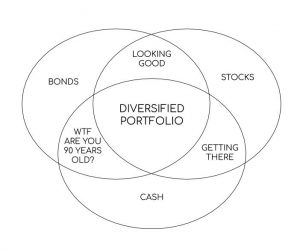
Venn Diagram of investing

After 40 years of saving and investing your stock portfolio can be chopped in half. I know, totally sucks! Let’s assume this happens but you are patient and will wait for a market recovery. According to Greg McBride: Typically, it takes stocks an average of 121 days, or four months, to recover from a correction. If a downturn becomes a bear market, which is when stocks fall 20 percent or more from a high, it takes an average of 22 months, which is less than two years, to recover.Dec 19, 2018”  

You don’t have control over what the stock market hands you, I guess it is a huge leap of faith, one that I took many years ago and I’m not going to lie, it’s a crazy ride. As Morpheus said in the Matrix, “Free your mind”